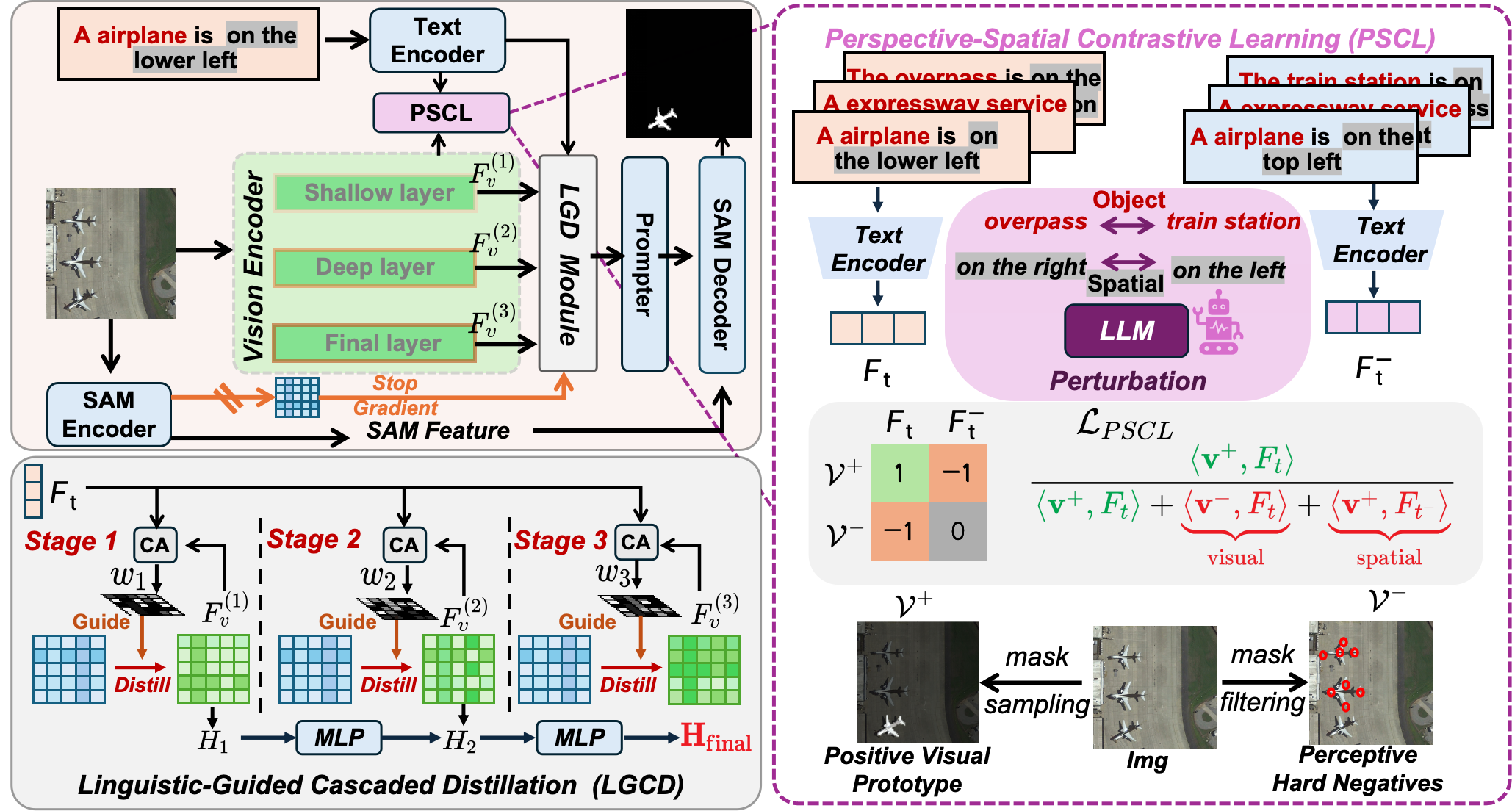
Referring Remote Sensing Image Segmentation (RRSIS) has achieved significant progress through the integration of VLMs and the Segment Anything Model (SAM). However, this progress largely relies on strong pre-trained capabilities, while leaving two fundamental limitations insufficiently addressed: (1) Architectural Weak-Coupling, where the unidirectional flow forces reliance on coarse VLM prompts and wastes SAM's pixel-level structural guidance, causing localization drift; and (2) Object-Centric Semantic Bias, where models overemphasize dominant object semantics while remaining insensitive to spatial reasoning crucial for RRSIS.
Motivated by these observations, we propose CROSS, a tightly integrated paradigm for RRSIS. First, we introduce Linguistic-Guided Cascaded Distillation (LGCD) to bridge the architectural gap, which distills SAM's geometric affinities as soft regularizers into VLM intermediate layers, injecting dense structural priors to refine localization. Second, Perspective-Spatial Contrastive Learning (PSCL) imposes cross-anchored constraints by mining mask-filtered deceptive distractors and spatial-linguistic counterfactuals as hard negatives, explicitly shattering semantic shortcuts to enforce genuine logical consistency.
Extensive experiments on RRSIS benchmarks demonstrate that CROSS achieves state-of-the-art performance and maintains precise localization even under severe spatial description perturbations, standing as a robust new paradigm for RRSIS.
@article{luo2026cross,
  title={CROSS: Cascaded Distillation and Dual-Constraint Grounding for Remote Sensing Referring Segmentation},
  author={Luo, Tingzhang and Liu, Ruizhong and Liu, Yichao and Fan, Cheng and Liu, Yu and Guo, Jianyuan},
  journal={arXiv preprint arXiv:2608.03147},
  year={2026}
}